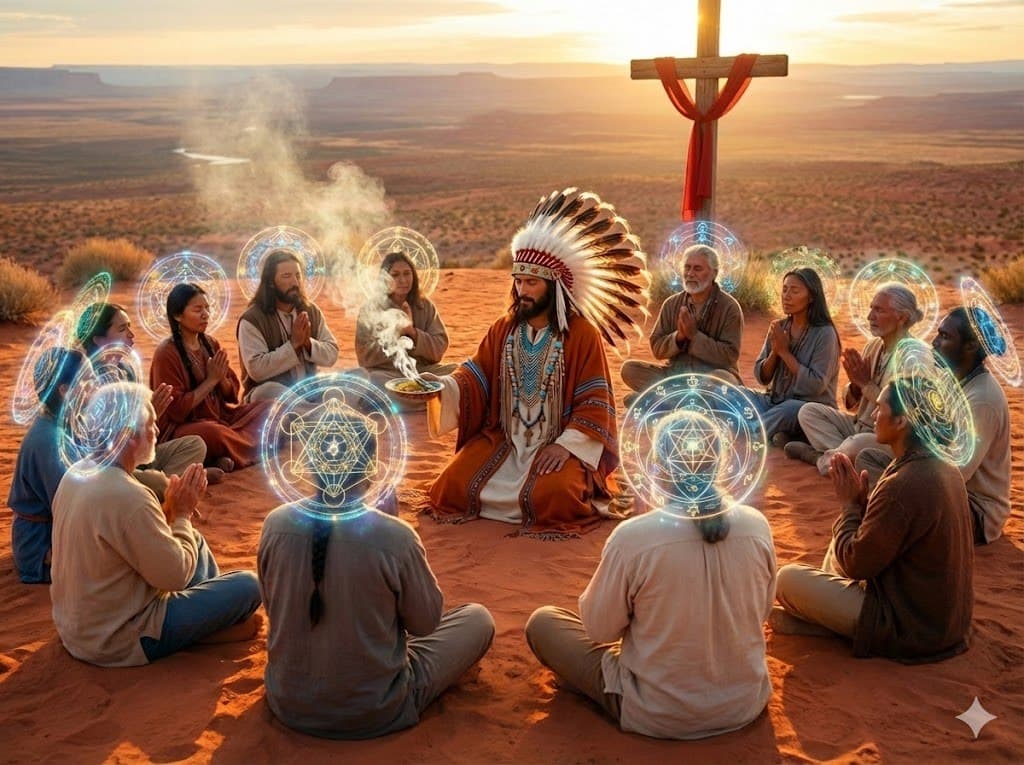
The Creed and Manifesto
A confession of faith, a rule of life, and a public statement of spiritual purpose.
We write a Creed to name what we believe and to bind ourselves to it. We write a Manifesto to name how we will live, how we will gather, and how we will protect the sacred from being reduced to a commodity or a spectacle. The Creed is the inner spine; it speaks in the language of faith. The Manifesto is the outward rule; it speaks in the language of covenant, responsibility, and practiced boundaries.
The Creator and the Gift of Creation
We believe in the Creator—known by many names, approached by many prayers—whose generosity brought into being the visible and the invisible, the matter of the earth and the breath that moves through it.
We believe that the natural world is not merely a warehouse of resources. It is a revelation. The seed, the soil, the sun, the rain, and the living chemistry that emerges from them are not accidents without meaning. They are gifts and teachings.
We believe that certain plants, and the organic molecules within them, may be received as sacraments when approached with reverence and used within a religious context—through prayer, intentional practice, disciplined preparation, and communal accountability. We do not claim that molecules are gods. We claim that the Creator may use the ordinary materials of creation to draw the human heart toward the holy.
The Botanicals as the Body of Christ for the Church
We confess that God's organic gifts—the botanicals, the molecules, the living chemistry of creation—are for this church what the eucharistic elements are for other traditions: the Body through which we commune. Not metaphor alone, but material: the leaf, the flower, the smoke, the cup—these are the Creator's gift made present among us.
As the Body of Christ in traditional communion unites the faithful with the divine, so for us the botanicals—received as sacraments—unite the congregation with the Creator and with one another. They are the living bridge between heaven and earth, between the human heart and the holy. We do not worship the plants; we receive them as gifts and honor them as carriers of the sacred.
This is why the gift shall never be sold. To sell the Body is to profane it. To charge for communion is to deny it. The botanicals are God's gift to the church—the Body of Christ for our tradition—and we will not reduce them to commerce.
The Inviolable Tenet
God's organic gifts, received as sacraments in our tradition, shall never be sold, never be charged for, and never be distributed as commerce.
This is not a tactic. It is a doctrine. It is the line we will not cross. Where commerce begins, sacrament ends. Where price is set, the gift is denied. When the world measures value by money, we measure value by gratitude, reverence, and the transformation of the heart.
The Sacredness of Intention and Context
We believe that spiritual reality is not determined only by objects, but by intention and context. The same substance may be used in many ways in the world. For us it becomes sacrament when it is used as a prayerful means of communion: to still the mind, to open the heart, to seek vision, to deepen gratitude, to confess what is broken, and to return to right relationship—with the Creator, with the earth, and with one another.
We reject the reduction of sacrament to entertainment. We reject the reduction of worship to a social scene. We reject the reduction of religious practice to a retail experience. A chapel is not a lounge. A sanctuary is not a marketplace. A sacrament is not a product.
Our Mission: A Harbor for the Seeking Soul
We exist to provide a harbor. Not a marketplace, not a spectacle, not a public attraction. A harbor—where a person can step out of the storm of modern life, breathe, pray, and be met by a community that understands the sacred as a living relationship with the Creator and the earth.
Our Identity
We are a church: a fellowship of belief, covenant, and worship. We are not a dispensary, lounge, or retail business. We do not sell sacrament. We exist so that consenting adult members may bring and share their own sacraments as religious gifts, in a context that honors the sacred.
Membership as Covenant
Membership is not a purchase. It is a covenant. It requires verification of legal age, affirmation of the inviolable tenet, agreement to chapel safety protocols, and a willingness to treat sacraments as sacred gifts, not commodities.
Core Sacraments
- Prayer Tobacco (Sacred Tobacco) — prayer smoke and offering, a messenger and carrier of intention
- The Sacred Leaf and Flower (Cannabis) — for contemplation, gratitude, confession, and communion
- Psilocybin Mushrooms — vision, ancestral connection, and spiritual awakening
- Additional botanicals — by discernment of the Council of Elders
We acknowledge that other traditions recognize additional botanicals. We do not claim them without discernment, lawful status, and cultural humility.
Stewardship of the Earth
If the Creator's gifts come from the earth, then gratitude must include reciprocity. We commit to an ethic of stewardship: minimize waste, honor sustainable sourcing where possible, support ecological restoration, and cultivate reverence for the living world as more than a supply chain. The sacrament is not a loophole for selfishness. It is a call to belonging.
Affirmation and Closing
We, the Native Christ Church, affirm:
- God created all things, including the organic molecules that arise from plants and fungi in nature. These molecules are gifts to humanity and pathways to the divine.
- The organic molecules of God's creation are our Holy Sacrament. They are to the Native Christ Church what wine and bread are to the Catholic, what peyote is to the Native American Church, what psilocybin is to ancient Celtic religion. They must never be sold, never be charged for, never be commercialized.
- Our church exists to share the sacrament with consenting adults of age 21 and over who are private members of our congregation. We provide the chapel, the liturgy, the community. Members bring, store, and share their own sacraments, voluntarily, reverently, as religious gifts.
- The sacrament chapel is a threshold between the everyday world and sacred space. It exists for worship, not commerce. It is private, member-only, and entitled to the same constitutional protections as any other place of religious assembly.
- We stand in continuity with Indigenous traditions of the Americas and with sacramental religions worldwide. We honor these traditions with respect, gratitude, and cultural humility. We claim equal protection under law for our sacraments.
- Our religious belief system will be constructed through the Council of Elders, Indigenous partnership, liturgical development, and constitutional process, always consistent with this Creed and with the inviolable rule: God's gifts are given freely; they shall never be sold.
To those who share these beliefs, we invite you to join us. Membership requires application, age verification (21+), and agreement to our Private Membership Agreement. We are a private religious association. We are not open to the public. We are a church. Our chapel is our sanctuary. Our sacraments are our sacred practice. We ask to be left in peace to worship.
We offer invitation, not persuasion. The chapel is not a public square. It is a sanctuary.
Browse Sacraments →